

I’d like to summarize probability density function (f(x)), expected value (E(X)) and variance (V(X)) of following probability distribution.
| Supergeometric distribution | ||
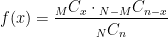 |
 |
|
 |
 |
|
 |
||
| Binomial distribution | ||
 |
 |
|
|
![\displaystyle 0 < p < 1[/latex]</td> </tr> <tr> <td><img src='https://s0.wp.com/latex.php?latex&bg=T&fg=000000&s=0' alt='' title='' class='latex' />\displaystyle V(X) = np(1 - p)](https://s0.wp.com/latex.php?latex=%5Cdisplaystyle+0+%3C+p+%3C+1%26%2391%3B%2Flatex%26%2393%3B%3C%2Ftd%3E++%3C%2Ftr%3E++%3Ctr%3E++%3Ctd%3E%5Blatex%5D%5Cdisplaystyle+V%28X%29+%3D+np%281+-+p%29&bg=T&fg=000000&s=0 "\displaystyle 0 < p < 1[/latex]</td> </tr> <tr> <td><img src='https://s0.wp.com/latex.php?latex&bg=T&fg=000000&s=0' alt='' title='' class='latex' />\displaystyle V(X) = np(1 - p)") |
|
| Poisson distribution | ||
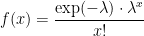 |
 |
|
 |
 |
|
 |
||
| Geometric distribution | ||
 |
 |
|
 |
![\displaystyle 0 < p < 1[/latex]</td> </tr> <tr> <td><img src='https://s0.wp.com/latex.php?latex&bg=T&fg=000000&s=0' alt='' title='' class='latex' />\displaystyle V(X) = \frac{1 - p}{p^2}](https://s0.wp.com/latex.php?latex=%5Cdisplaystyle+0+%3C+p+%3C+1%26%2391%3B%2Flatex%26%2393%3B%3C%2Ftd%3E++%3C%2Ftr%3E++%3Ctr%3E++%3Ctd%3E%5Blatex%5D%5Cdisplaystyle+V%28X%29+%3D+%5Cfrac%7B1+-+p%7D%7Bp%5E2%7D&bg=T&fg=000000&s=0 "\displaystyle 0 < p < 1[/latex]</td> </tr> <tr> <td><img src='https://s0.wp.com/latex.php?latex&bg=T&fg=000000&s=0' alt='' title='' class='latex' />\displaystyle V(X) = \frac{1 - p}{p^2}") |
|
| Negative binomial distribution | ||
 |
|
|
 |
||
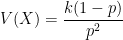 |
||
| Normal distribution | ||
 |
![\displaystyle - \infty < x < \infty[/latex]</td> </tr> <tr> <td><img src='https://s0.wp.com/latex.php?latex&bg=T&fg=000000&s=0' alt='' title='' class='latex' />\displaystyle E(X) = m](https://s0.wp.com/latex.php?latex=%5Cdisplaystyle+-+%5Cinfty+%3C+x+%3C+%5Cinfty%26%2391%3B%2Flatex%26%2393%3B%3C%2Ftd%3E++%3C%2Ftr%3E++%3Ctr%3E++%3Ctd%3E%5Blatex%5D%5Cdisplaystyle+E%28X%29+%3D+m&bg=T&fg=000000&s=0 "\displaystyle - \infty < x < \infty[/latex]</td> </tr> <tr> <td><img src='https://s0.wp.com/latex.php?latex&bg=T&fg=000000&s=0' alt='' title='' class='latex' />\displaystyle E(X) = m") |
|
 |
 |
|
| Exponential distribution | ||
 |
 |
|
 |
![\displaystyle x < 0[/latex]</td> </tr> <tr> <td><img src='https://s0.wp.com/latex.php?latex&bg=T&fg=000000&s=0' alt='' title='' class='latex' />\displaystyle E(X) = \frac{1}{\lambda}](https://s0.wp.com/latex.php?latex=%5Cdisplaystyle+x+%3C+0%26%2391%3B%2Flatex%26%2393%3B%3C%2Ftd%3E++%3C%2Ftr%3E++%3Ctr%3E++%3Ctd%3E%5Blatex%5D%5Cdisplaystyle+E%28X%29+%3D+%5Cfrac%7B1%7D%7B%5Clambda%7D&bg=T&fg=000000&s=0 "\displaystyle x < 0[/latex]</td> </tr> <tr> <td><img src='https://s0.wp.com/latex.php?latex&bg=T&fg=000000&s=0' alt='' title='' class='latex' />\displaystyle E(X) = \frac{1}{\lambda}") |
|
 |
||
| Gamma distribution | ||
 |
|
|
|
![\displaystyle x < 0[/latex]</td> </tr> <tr> <td><img src='https://s0.wp.com/latex.php?latex&bg=T&fg=000000&s=0' alt='' title='' class='latex' />\displaystyle E(X) = \frac{\alpha}{\lambda}](https://s0.wp.com/latex.php?latex=%5Cdisplaystyle+x+%3C+0%26%2391%3B%2Flatex%26%2393%3B%3C%2Ftd%3E++%3C%2Ftr%3E++%3Ctr%3E++%3Ctd%3E%5Blatex%5D%5Cdisplaystyle+E%28X%29+%3D+%5Cfrac%7B%5Calpha%7D%7B%5Clambda%7D&bg=T&fg=000000&s=0 "\displaystyle x < 0[/latex]</td> </tr> <tr> <td><img src='https://s0.wp.com/latex.php?latex&bg=T&fg=000000&s=0' alt='' title='' class='latex' />\displaystyle E(X) = \frac{\alpha}{\lambda}") |
 |
 |
||
| Beta distribution | ||
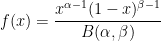 |
![\displaystyle 0 < x < 1[/latex]</td> </tr> <tr> <td><img src='https://s0.wp.com/latex.php?latex&bg=T&fg=000000&s=0' alt='' title='' class='latex' />\displaystyle f(x) = 0](https://s0.wp.com/latex.php?latex=%5Cdisplaystyle+0+%3C+x+%3C+1%26%2391%3B%2Flatex%26%2393%3B%3C%2Ftd%3E++%3C%2Ftr%3E++%3Ctr%3E++%3Ctd%3E%5Blatex%5D%5Cdisplaystyle+f%28x%29+%3D+0&bg=T&fg=000000&s=0 "\displaystyle 0 < x < 1[/latex]</td> </tr> <tr> <td><img src='https://s0.wp.com/latex.php?latex&bg=T&fg=000000&s=0' alt='' title='' class='latex' />\displaystyle f(x) = 0") |
 |
 |
||
 |
||
| Cauchy distribution | ||
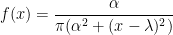 |
 |
|
| Log-normal distribution | ||
 |
 |
|
|
 |
|
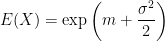 |
|
|
](https://s0.wp.com/latex.php?latex=%5Cdisplaystyle+V%28X%29+%3D+%5Cexp%5B2m+%2B+%5Csigma%5E2%5D%28%5Cexp%5B%5Csigma%5E2%5D+-+1%29&bg=T&fg=000000&s=0 "\displaystyle V(X) = \exp[2m + \sigma^2](\exp[\sigma^2] - 1)") |
||
| Pareto distribution | ||
 |
 |
|
|
![\displaystyle x < 0[/latex]</td> </tr> <tr> <td><img src='https://s0.wp.com/latex.php?latex&bg=T&fg=000000&s=0' alt='' title='' class='latex' />\displaystyle E(X) = \frac{ax_0}{a - 1}](https://s0.wp.com/latex.php?latex=%5Cdisplaystyle+x+%3C+0%26%2391%3B%2Flatex%26%2393%3B%3C%2Ftd%3E++%3C%2Ftr%3E++%3Ctr%3E++%3Ctd%3E%5Blatex%5D%5Cdisplaystyle+E%28X%29+%3D+%5Cfrac%7Bax_0%7D%7Ba+-+1%7D&bg=T&fg=000000&s=0 "\displaystyle x < 0[/latex]</td> </tr> <tr> <td><img src='https://s0.wp.com/latex.php?latex&bg=T&fg=000000&s=0' alt='' title='' class='latex' />\displaystyle E(X) = \frac{ax_0}{a - 1}") |
 |
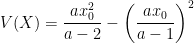 |
 |
|
| Weibull distribution | ||
![\displaystyle f(x) = \frac{\gamma x^{\gamma - 1}}{\lambda^b}\exp\left[-\left(\frac{x}{y}\right)^\gamma\right]](https://s0.wp.com/latex.php?latex=%5Cdisplaystyle+f%28x%29+%3D+%5Cfrac%7B%5Cgamma+x%5E%7B%5Cgamma+-+1%7D%7D%7B%5Clambda%5Eb%7D%5Cexp%5Cleft%5B-%5Cleft%28%5Cfrac%7Bx%7D%7By%7D%5Cright%29%5E%5Cgamma%5Cright%5D&bg=T&fg=000000&s=0 "\displaystyle f(x) = \frac{\gamma x^{\gamma - 1}}{\lambda^b}\exp\left[-\left(\frac{x}{y}\right)^\gamma\right]") |
|
|
|
![\displaystyle x < 0[/latex]</td> </tr> <tr> <td><img src='https://s0.wp.com/latex.php?latex&bg=T&fg=000000&s=0' alt='' title='' class='latex' />\displaystyle E(X) = \lambda\Gamma\left(1 + \frac{1}{\gamma}\right)](https://s0.wp.com/latex.php?latex=%5Cdisplaystyle+x+%3C+0%26%2391%3B%2Flatex%26%2393%3B%3C%2Ftd%3E++%3C%2Ftr%3E++%3Ctr%3E++%3Ctd%3E%5Blatex%5D%5Cdisplaystyle+E%28X%29+%3D+%5Clambda%5CGamma%5Cleft%281+%2B+%5Cfrac%7B1%7D%7B%5Cgamma%7D%5Cright%29&bg=T&fg=000000&s=0 "\displaystyle x < 0[/latex]</td> </tr> <tr> <td><img src='https://s0.wp.com/latex.php?latex&bg=T&fg=000000&s=0' alt='' title='' class='latex' />\displaystyle E(X) = \lambda\Gamma\left(1 + \frac{1}{\gamma}\right)") |
 |
![\displaystyle V(X) = \lambda^2\left[\Gamma\left(2 + \frac{1}{\gamma}\right) - \left(\Gamma\left(1 + \frac{1}{\gamma}\right)\right)^2\right]](https://s0.wp.com/latex.php?latex=%5Cdisplaystyle+V%28X%29+%3D+%5Clambda%5E2%5Cleft%5B%5CGamma%5Cleft%282+%2B+%5Cfrac%7B1%7D%7B%5Cgamma%7D%5Cright%29+-+%5Cleft%28%5CGamma%5Cleft%281+%2B+%5Cfrac%7B1%7D%7B%5Cgamma%7D%5Cright%29%5Cright%29%5E2%5Cright%5D&bg=T&fg=000000&s=0 "\displaystyle V(X) = \lambda^2\left[\Gamma\left(2 + \frac{1}{\gamma}\right) - \left(\Gamma\left(1 + \frac{1}{\gamma}\right)\right)^2\right]") |
 |
